Part 1 in a series | M&A has changed. Spreadsheets and disconnected tools can't keep up. Discover how modern M&A software is evolving and what that means for teams running active programs.
February 20, 2026
•
5 minutes
•
Midaxo Communications Team
Contents
What M&A intelligence means to us
An evolution, not a starting point
Why this matters now
Coming next in the series
M&A has always been complex. That hasn't changed. What has changed is how much is expected of the teams running it.
Fifteen years ago, when we started Midaxo, most corporate development teams tracked deals in spreadsheets and managed diligence through email. The bar for "good process" was low. If you closed the deal and nobody forgot a critical workstream, that counted as success.
Today, the expectations are different. Boards want more insight into how M&A connects to corporate strategy. CFOs want better data and proof of value realization. Integration teams want to capture synergies, and be able to easily prove they did. PE firms want visibility across every portfolio company's deal activity.
The question has shifted from "did we close the deal?" to "is our M&A program delivering value?"
That's a fundamentally different question. And it requires a different kind of system to answer. The category of M&A software has had to evolve — from multiple tools that store deal information to all-in-one platforms that help teams act on data. We call that shift the shift toward M&A intelligence. And it's what the M&A Intelligence Platform is built around.
System of Record → System of Intelligence
What M&A intelligence means to us
We've worked with M&A teams for over a decade. The pattern we see is consistent: organizations start by adopting a tool to solve one problem, usually pipeline tracking or diligence coordination, and then realize the real challenge is not one single phase, but connecting the pieces.
A deal that looks strong in pipeline doesn't always survive diligence. An acquisitionthat closes on time can still fail in integration. Synergies that looked clear on paper disappear when nobody tracks them post-close.
The information exists. It's just scattered and hard to keep track of when you have one tool for pipeline, another for diligence, spreadsheets for integration, slides for executive updates. The result of a disparate system is visibility without orchestration, siloed workflows, difficult handoffs, and lost context.
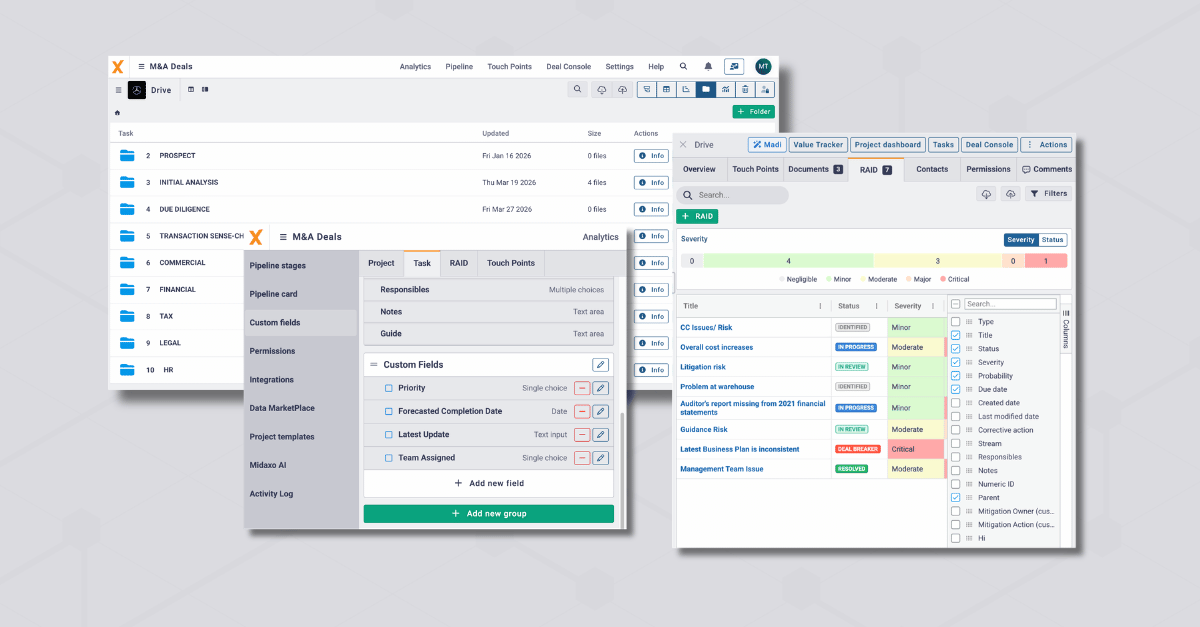
An M&A intelligence Platform changes that. It brings all your processes and information into one connected system and allows you to automate M&A workflows to reduce friction. It means insight into what matters, when it matters, and orchestration that turns strategy into repeatable execution.
To shift from a system of record to a system of intelligence, said system needs to learn from your deal history to surface what matters – with AI-powered insights that connect context across the deal lifecycle. Then, patterns across your pipeline inform how you prioritize; integration planning starts with context from diligence, not a blank spreadsheet; and leadership can get answers without someone spending hours assembling a report.
M&A intelligence is achieved when the data and processes for strategy, pipeline, diligence, integration, and value tracking live in one platform, and the platform works with your team to make sense of it all. And then, just like that, rather than reacting, you're executing systematically.
Midaxo has supported thousands of deals across enterprise organizations worldwide. Industry analyst IDC has recognized that work: it named Midaxo a Leader in the IDC MarketScape: Worldwide Mergers & Acquisitions Software 2024 Vendor Assessment, and a Leader in the IDC MarketScape: Worldwide AI-Enabled Deal Management 2025 Vendor Assessment.
That foundation matters. The platform we built to support deal execution doesn't come from a blank slate, it comes from deep domain expertise, years of deal data patterns, and a desire to build a tool for specifically for how M&A teams work—not patch systems together or adapt from existing general project management or CRM software.
This is where Midaxo has been heading since day one and where the best M&A teams are already operating. A system that both stores deal information and helps teams act on it—that surfaces the right context at the right moment and lets every deal benefit from the ones that came before.
Why this matters now
Three things are converging:
Deal complexity is increasing. Cross-border transactions, regulatory scrutiny, ESG requirements, technology integrations, the number of variables in every deal continues to grow. Teams that rely on manual tracking can't keep up.
Boards expect accountability. M&A is no longer allowed to be a black box. Leadership wants structured reporting on pipeline health, deal progress, integration milestones, and value delivered. Quarterly. Sometimes monthly.
The technology has caught up. For years, the tools available to M&A teams lagged behind, but that gap is closing. Systems can now process deal data in ways that surface patterns, flag risks, and reduce the manual work that slows teams down, without replacing the judgment that makes M&A successful. For a deeper look at how this is playing out, see our guide to AI in M&A.
As M&A programs are held to the same operational standards as other business functions, teams relying on M&A software point solutions carry more risk — not because they lack capability, but because their infrastructure doesn't support the visibility that repeatable execution requires.
The teams that operate within an M&A Intelligence Platform have an edge They see what others miss and they move faster because they spend less time assembling information and more time acting on it.
Coming next in the series
Over the coming weeks, we'll share more about how the move toward M&A intelligence plays out in practice, across pipeline management, diligence, integration, and value tracking: concrete examples from how teams use Midaxo to run their M&A programs today.
If you're running an active M&A program and want to see what this looks like inside the platform, we'd welcome the conversation. See it in action →
.webp)

.png)





.webp)