Article
Deal sourcing & pipeline
Deal management software for M&A: structure and selection
Deal management software keeps every acquisition structured from sourcing to close. Here's what to look for when choosing a tool.
Article
Deal sourcing & pipeline
Deal management software keeps every acquisition structured from sourcing to close. Here's what to look for when choosing a tool.
July 2, 2026
•
5 minutes
The way teams work has shifted. AI now handles parts of the daily routine, and for M&A that means enriching targets and helping score them against the thesis, but the underlying tracking often still runs on spreadsheets and shared drives. That setup holds up well until a second deal opens, a target moves into diligence, or leadership asks for a pipeline update that eats half a day to assemble—usually the point a team starts looking for deal management software.
That pain point is showing up more often. M&A momentum climbed through the second half of 2025 and into 2026, with deal values rising and larger, more complex transactions returning, according to A&O Shearman's December 2025 Global M&A Insights. More deals in motion means more competing for a small team's attention, and that's exactly when a loose pipeline starts to cost real money.
Deal management software is the layer that tracks every opportunity through the pipeline, from first contact to close. It sits inside the wider M&A software category. This piece covers two practical questions: how to structure deal management so it holds up as volume grows, and what to look for when choosing a tool.
The unit of work in deal management is the deal, not the contact. Each deal carries its own targets, owners, documents, scores, and next steps, and it moves through stages that reflect how acquisitions actually run.
That makes it different from a general CRM, which is built around contacts and a more generic repeatable sales funnel. If you are weighing whether to extend the CRM you already have, that comparison is worth reading on its own: see M&A CRM vs a general CRM. Deal management is also narrower than the full category: it is the pipeline phase, the front of the deal lifecycle, not the diligence and integration layers that come after. Bought as a standalone tool, it stays that narrow. The strongest implementations treat it as the front end of something larger, so the pipeline hands off cleanly into what comes next.
The stages should ideally mirror how acquisitions actually move, rather than a generic sales funnel. A workable M&A pipeline usually runs Identified, Qualified, Approached, Under LOI, In diligence, Signed, Closed, and In integration—stages that reflect where deals actually get stuck, which a prospect-to-closed-won funnel doesn't show.
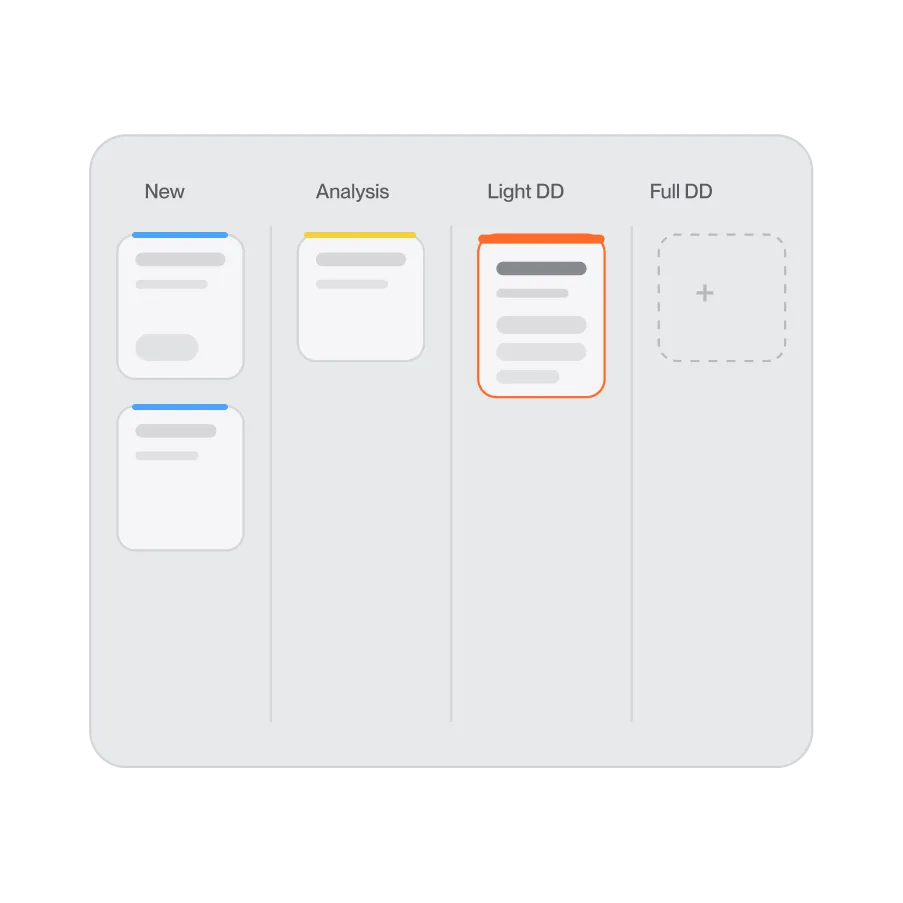
The key is having the deal itself as the record everything attaches to: the target, the owner, criteria scores, key contacts, documents, decisions, and a single next action, all in one place. When that context is built during sourcing, it's still there months later when the deal moves into due diligence rather than needing to be reconstructed.
Ownership matters just as much: a deal with no clear owner and no agreed next step tends to gather dust until it dies; one name and one next action per deal is usually enough to prevent that, and a deal management platform with notifications and tagging makes accountability easy.
Plus a short weekly review from your deal card—complete with stage, owner, next action, date of last movement—tends to do more for alignment than a monthly deck ever will. Once the pipeline is structured this way, board updates become turnkey, rather than something you have to rebuild from scratch each time.
AI has reached the pipeline faster than any other part of the deal. Bain reported that AI adoption among M&A teams more than doubled in 2025, and sourcing and screening are where it is used most (Bain, January 2026).
Useful AI here is specific. It enriches target records automatically, so the deal data stays current without manual entry. It scores and prioritizes targets against your criteria, surfacing fit rather than gut feel. It flags deals that have stalled or drifted from the thesis before they go quiet. And it drafts the board or pipeline update from live data instead of having someone rebuild it by hand.
The pattern is the same across all of them: the software surfaces the signal, the deal team makes the call. The stakes in M&A are too high to hand decisions to an autonomous system.
The direction is agentic. Rather than waiting to be asked, the platform proactively surfaces what matters: a deal with no recent movement, a target that now fits the thesis, a number that moved since the last review. That keeps the team on judgment instead of on tracking down where each deal stands. Midaxo AI is built into the pipeline this way, embedded across the deal rather than bolted on.
Treat the evaluation as a short set of questions.
The question of "whether deal data carries past close" is really the one that matters most of everything above. A tool can model stages well, track approvals, and score targets cleanly, and still leave a team rebuilding context the moment a deal signs. The strongest deal management software avoids that by staying connected to what comes next, rather than existing as a point tool. We go into why that distinction matters, and what it costs teams who get it wrong, in the CRM comparison piece mentioned above.
For teams that have outgrown the spreadsheet, the gain is not just a tidier pipeline. It is the context that survives from first contact to closed deal. If you are weighing how to structure that, or a move off the spreadsheet, book a demo and we will map it against your existing process.
Jul 8, 2026
•
5 minutes