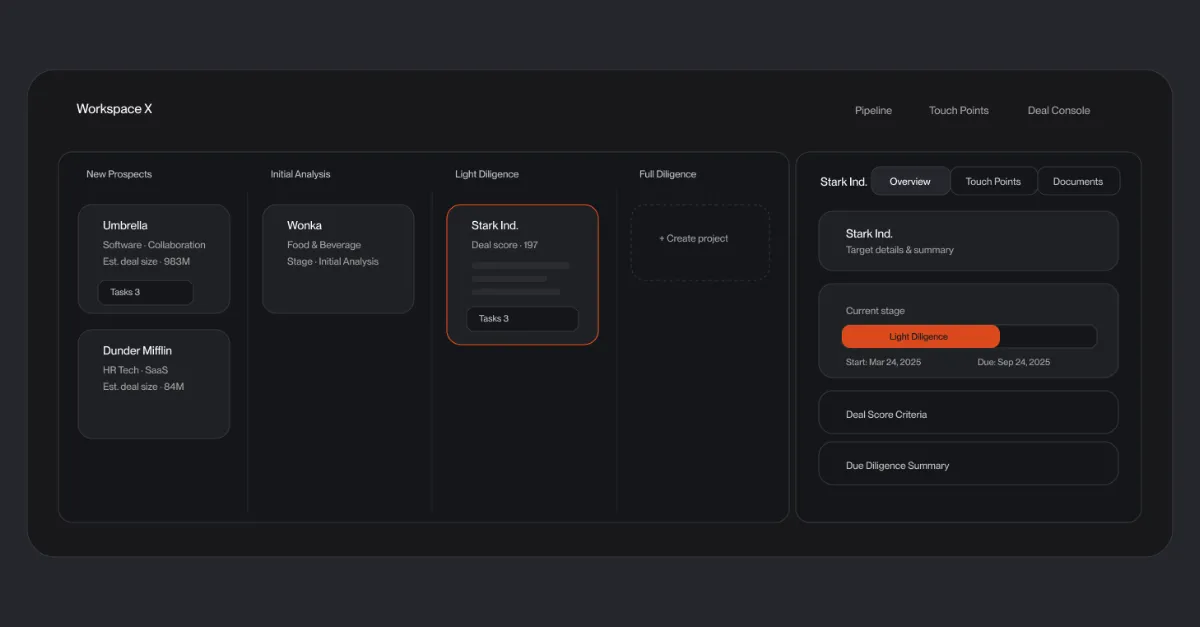
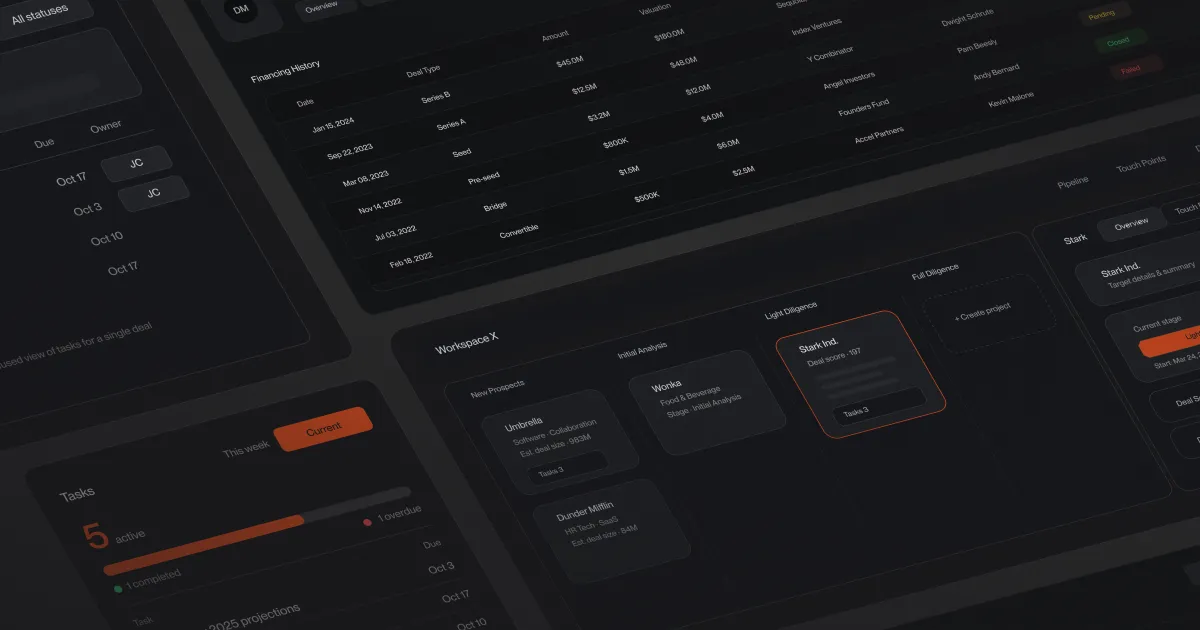
Q1 2026 has been a significant quarter for Midaxo. The company launched a new positioning (the M&A Intelligence Platform) and closed its first quarter with customer wins across the US and Europe, spanning private equity, enterprise, and mid-market organizations. Behind those results is a new leadership team with a clear point of view on where M&A technology is heading and what Midaxo is building to get there.
At the helm is CEO Erica Magnergård, who joined Midaxo in January to lead the company into its next phase of growth, alongside Chief Product Officer Vil Audinis, who brings seven years of product experience at Midaxo to the role. Together, they are shaping both the company's direction and the platform it is building to support it. We spoke with Erica and Vil about the quarter, the new positioning, and what comes next.
“M&A teams deserve a system that works the way they do”
Midaxo launched as the M&A Intelligence Platform in February. What does that shift in positioning mean in practice?
Erica Magnergård, CEO: “The ‘deal management’ framing always described what the software does, not what customers get out of it. What our customers are actually trying to do is run M&A as a reliable, repeatable program, not just close individual transactions. M&A Intelligence is about giving teams the visibility to do that: across the pipeline, through diligence, into integration, and all the way to value realization. That is what we have always been building. The new positioning reflects it more accurately.”
What has the response been like —from customers and from the market?
Erica: “The conversations have changed. When we talk about intelligence rather than management, people immediately understand the problem we are solving — the loss of context and continuity between M&A phases. That is a real pain point for corporate development teams and finance leaders. They have been trying to solve it with spreadsheets and disconnected tools for years. We are hearing more recognition that there is a better way.”
A strong Q1 across diverse customer profiles
The first quarter produced significant new customer wins. What stands out about the companies choosing Midaxo right now?
Erica: “The range. We have new customers in private equity, enterprise construction, industrial technology, and mid-market businesses running ten-plus acquisitions a year. What they share isa recognition that Excel and generic project tools are not built for M&A, and that the cost of that becomes visible the moment a deal gets complex or a team tries to repeat what worked last time. They are choosing Midaxo because they want a system that holds the full lifecycle together, not just one phase of it.”
Q1 also shows momentum in the mid-market — companies running frequent deal volume but without the infrastructure of a large corporate development team. Is that an intentional focus?
Erica: “It is a natural fit. These are organizations doing real M&A volume — often ten or more deals a year — and they have outgrown the tools they started with. They need the discipline and repeatability that larger teams have built, but without a team of twenty to maintain it. That is exactly what Midaxo is designed to support.”
Building the Intelligence layer
Vil, you have been at Midaxo for seven years and recently stepped into the Chief Product Officer role. What does“M&A Intelligence” mean from a product standpoint?
Vil Audinis, CPO: “It means the platform connects the data and context that typically gets lost between M&A phases. Deal and diligence teams surface critical findings — but that insight rarely travels cleanly into integration planning. A pipeline team tracks deal rationale — but that logic is rarely available when the integration team is setting priorities six months later. Intelligence means that such context is preserved, structured, and accessible throughout the lifecycle. The platform does not replace the judgment of the people running the deal, but it does makes sure that such judgment is informed by the full picture.”
What are you focused on building in the near term?
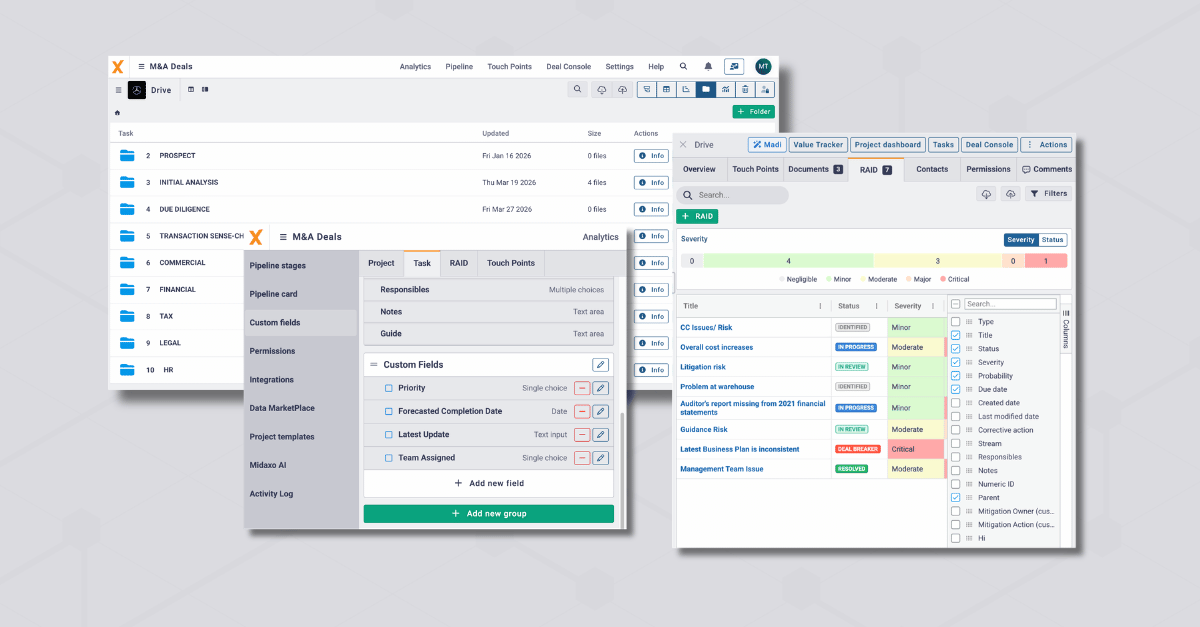
Vil: “Two things in parallel. The first is reducing friction for the teams who use the platform every day. For example, we recently introduced a grid view for project tasks — it works the way a spreadsheet does, because that is what people know. If someone finds the task tree complex, they can switch to the grid and keep moving. That matters for adoption, which matters for whether the platform actually gets used. We also shipped an adaptive project dashboard that lets teams view and edit all project-related data live, without having to move around the product or exporting to Excel and re-importing — a cycle I know a lot of teams still rely on. And RAID logs now support custom fields, so teams can structure risk and issue tracking around how their deal actually works, not a fixed template we impose on them.
The second thread is deeper: connecting the data that travels between phases. A diligence team captures findings that should shape integration priorities. A pipeline team documents deal rationale that should still be accessible when the integration is six months in. We are building the structures that make that continuity possible, not just storing data, but making it accessible and actionable in context, when it is needed.”
How do you think about AI’s role in that — given how much attention it is getting in enterprise software right now?
Vil: “AI is useful in M&A when it helps people make better decisions, but not as much for when it tries to make decisions for them. The stakes are too high and the context too specific for that. A deal team does not need AI to tell them what to do. They need AI that surfaces the risk that was logged three weeks ago and never followed up, or flags that a dependency in the integration plan maps to an open issue in diligence.That kind of signal — fast, in context, without someone having to go looking for it — is where AI earns its place in this workflow. The decision stays with the people who understand the deal.”
Looking ahead
As Q1 closes, what does the rest of 2026 look like for Midaxo?
Erica: “We have strong momentum and a clear product direction. Being named a Leader in the IDC MarketScape: WorldwideAI-Enabled Deal Management 2025 Vendor Assessment tells us we are building in the right direction. What we are focused on now is execution: helping new customers get to value faster, deepening the platform’s intelligence layer, and continuing to grow in the markets where M&A activity is highest. We’re happy to be starting the year in an even better position than we ended the last one.”
Midaxo is the M&A Intelligence Platform—purpose-built to help corporate development teams, finance leaders, and integration managers run deals with clarity, control, and repeatability. Midaxo has been named a Leader in the IDC MarketScape: Worldwide AI-Enabled DealManagement 2025 Vendor Assessment (doc #US52999425, November 2025). See it in action by requesting a demo.
Erica Magnergård is CEO of Midaxo. Before joining, she served as CEO of Nordkap AB, a SaaS platform for finance teams in Nordic real estate. Under her leadership, Nordkap became the segment's market leader, serving over 60% of Sweden's publicly listed property companies, before being acquired by its largest competitor. She brings a track record of scaling SaaS platforms from product-market fit to category leadership.


.png)




.webp)