Article
Product & platform
Your deal process, your way: How Midaxo's Q1 updates give you more control
No two deal teams work alike. Your M&A management platform should reflect that.
Article
Product & platform
No two deal teams work alike. Your M&A management platform should reflect that.
April 13, 2026
•
3 minutes
M&A is a discipline with universal stages — screen, diligence, integrate, track value — but the way teams move through those stages is more varied. Your pipeline looks different from your peer's. Your diligence workflow has nuances that a generic tool would flatten. Your team's communication rhythms are its own.
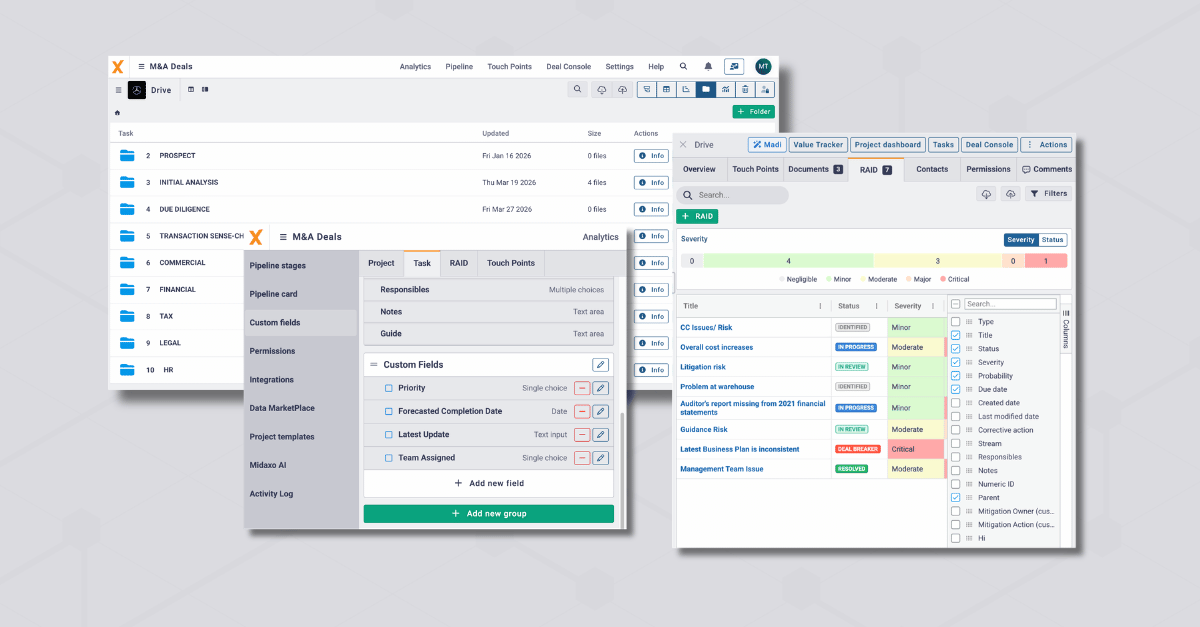
Midaxo has always connected strategy, pipeline, diligence, integration, and value tracking in one place. What the bulk of our Q1 releases do is give your team far more flexibility and control over how the platform shows up for you. From the fields you track, to the views your team sees, to the notifications that reach your inbox, this is the thread that runs through almost every update we shipped last quarter: customizability that meets you where you are.
When a platform has strong opinions about how work should look, teams adapt to the tool rather than the other way around. In a domain as high-stakes and time-pressured as M&A, that friction has a real cost: people scroll past fields that don't apply to them, notifications arrive that weren't meant for them, and status systems quietly misrepresent how a team actually operates.
We started Q1 by asking where that friction was highest. The answer came back quickly: Tasks, Touch Points, and the RAID log. These are the three areas of the platform where active deal teams spend a lot of time and where the gap between "what the platform assumes" and "what the team actually does" was most visible.
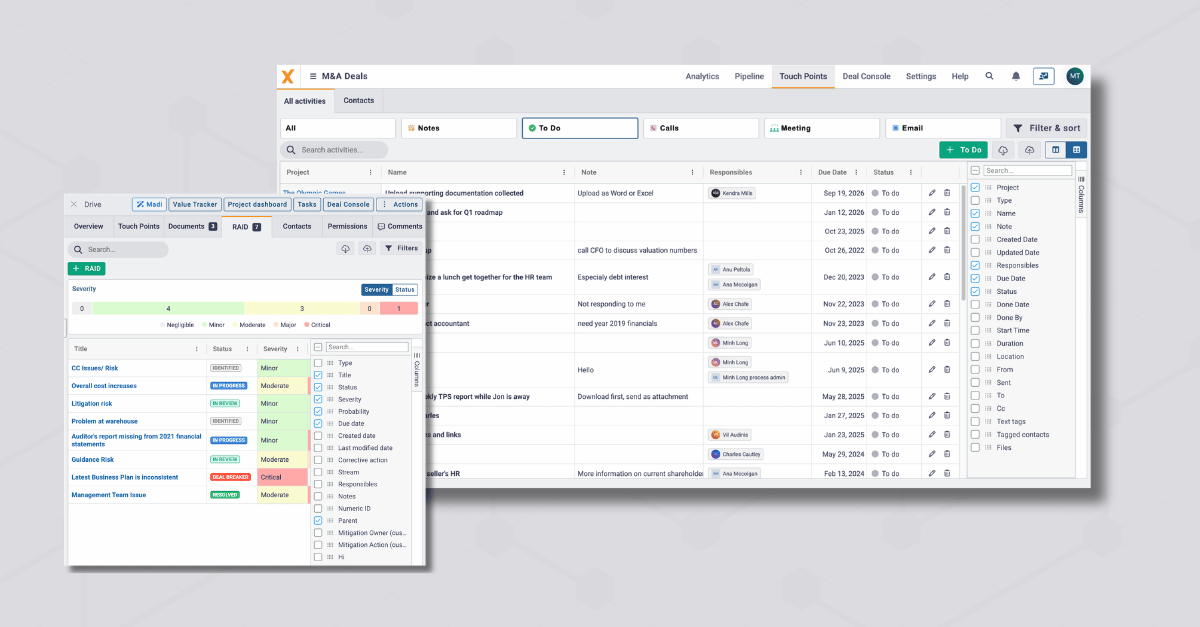
The updates we shipped across Tasks, Touch Points, and the RAID log all follow the same logic: give teams control over which fields are visible, who can edit them, and how the view is filtered, without requiring each person to manage that themselves.
You can now more easily customize which fields are visible and create filters tailored to how your team actually operates. If your integration team tracks different data points than your diligence team, they can each work in a view that reflects that, drawing from the same underlying data. No duplicate records. No scrolling past fields that don't apply. Just the information that's relevant to the work in front of you.
A separate thread of work this quarter was about making information faster to act on at a glance.
Cover Page Fields now support color coding of individual field values. Before this, Cover Pages could quickly get cluttered with all the intended data to see “at a glance”. But many found it easier to open a record to fully understand a deal status. Now, a quick scan of the pipeline tells you which deals are on track, which need attention, and which have stalled without clicking into anything. The signal is immediate.
The new Activity Log makes the audit trail of everything happening across a workspace easier to review. For teams that need to reconstruct a timeline or understand what changed and when, it removes a step that used to require more digging.
Not everything ships with a headline. A few Q1 updates are the kind of thing you notice because something that used to interrupt you no longer does.
Navigation between projects is smoother now — updating a cover page no longer costs you your place in the workflow. Default notification settings can be configured at the workspace level, so your team isn't each independently managing their own preferences. And admins can now disable automatic overdue status on tasks, which matters for teams whose work doesn't map cleanly onto a binary on-time/late model.
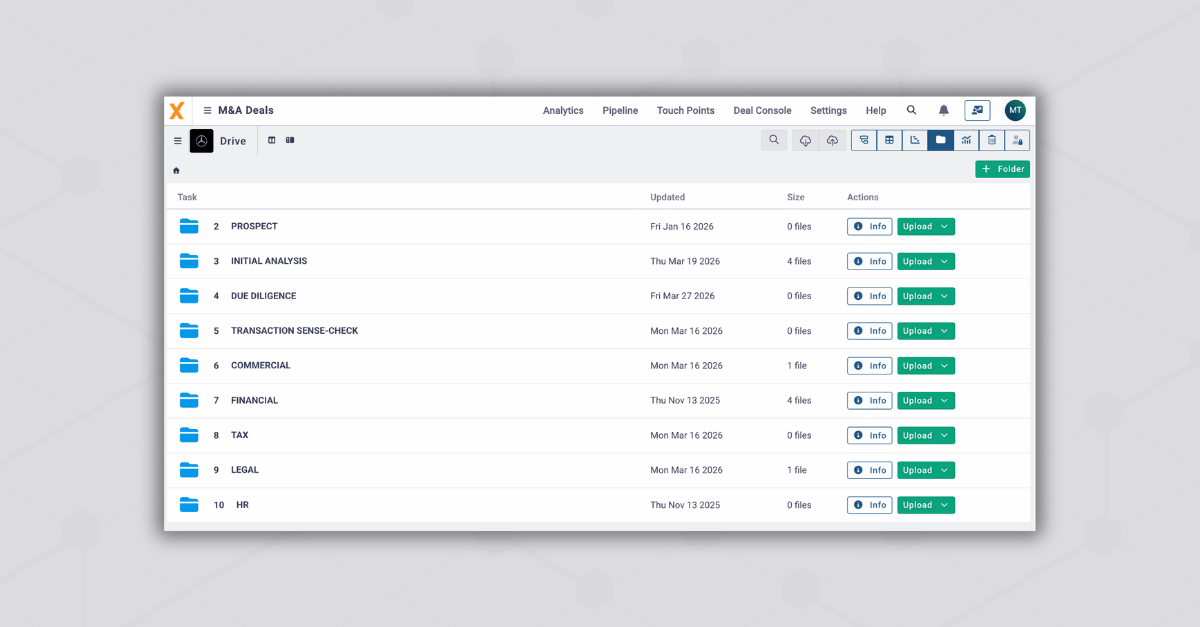
For teams doing active diligence, the Virtual Data Room folder view has been updated to bring back a classic document browsing experience for less time orienting, more time analyzing. Admins also have new control over VDR Q&A visibility: comments can now be made automatically visible to non-Guest users, cutting down on the manual access management that tends to pile up during active diligence.
Under new CEO Erica Magnegård and Chief Product Officer Vil Audinis, the product direction is straightforward: make the platform sharper, faster, and more useful at every stage of the deal lifecycle.
The core capability hasn't changed. Midaxo still connects strategy, pipeline, diligence, integration, and value tracking in one place. What's changing is how precisely teams can shape it to fit the way they actually work.We'll keep shipping from that premise.
Want to see these updates in your workspace? Contact us →
Apr 16, 2026
•
3 minutes

.png)





.webp)