Article
Product & platform
M&A Software in 2026: A Practical Guide for Deal Teams
A look at how M&A software has evolved, what to evaluate, and where the category is going next.
Article
Product & platform
A look at how M&A software has evolved, what to evaluate, and where the category is going next.
April 15, 2026
•
6 minutes
•
M&A software supports every step of a deal, from sourcing targets to integrating the business after close. The category of such software has shifted in the past three years: spreadsheets and email threads no longer hold up at scale. Instead, teams running multiple deals in parallel need one connected system that keeps strategy, pipeline, diligence, and integration in the same place.
This post walks through what M&A software is, what it does, what to look for when evaluating it, and how the category is changing as AI moves from feature to layer.
M&A software is a category of business applications built for the work of mergers and acquisitions. It supports the activities a deal team performs from the first target screening through post-close integration and value realization.
The category developed because the standard tools used by other functions (general project management systems, customer CRMs, document repositories) do not always match how M&A actually runs, with a deal carried through multiple phases that look very different from each other. Pipeline work is research-heavy and relationship-driven. Diligence is data-intensive and time-bound. Integration is operational and coordinative. Value tracking is financial and ongoing.
A team running multiple deals needs one place to hold all of it. That is what M&A software is built for.
Most M&A software platforms cover four core areas.
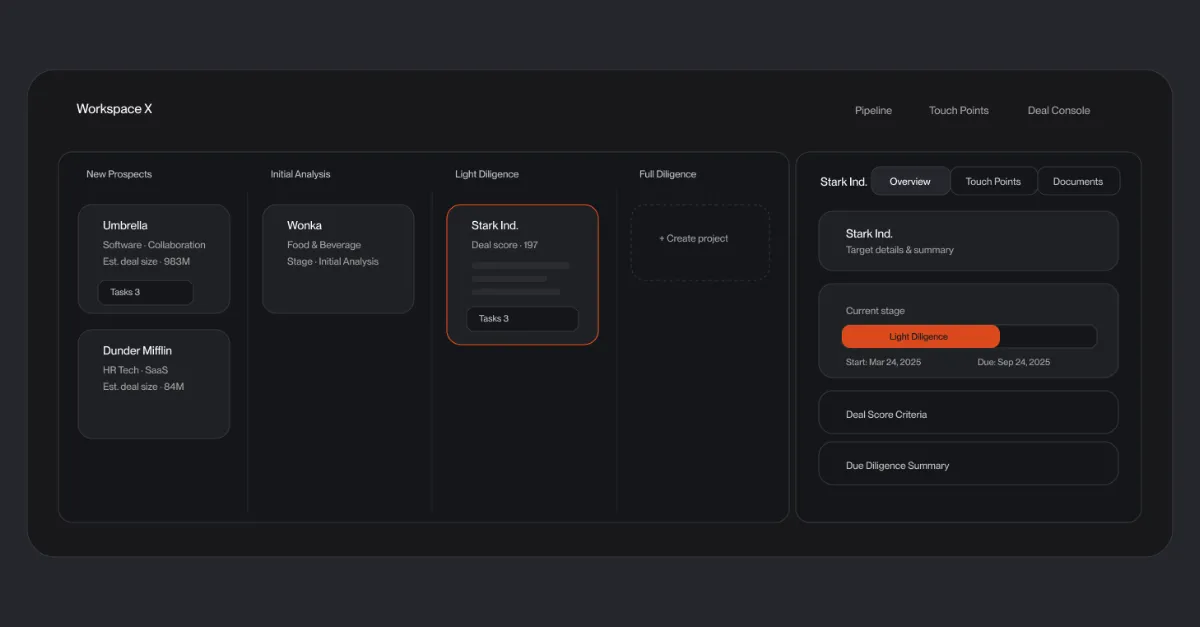
Pipeline and CRM. This is where teams track target companies, score them against investment criteria, monitor relationship activity, and run repeatable screening. It's the layer that, when managed well, turns ad-hoc sourcing into a managed program.
Due diligence. In this phase teams need to coordinate cross-functional workstreams, manage findings and risks, route documents securely, and maintain audit trails. Diligence is where deal economics get verified or unwound.
Closing and approval workflows. Once the initial due diligence is done, teams need to move documents through internal review, capture sign-offs, and prepare for transfer to integration teams.
Integration and value tracking. The handoff between diligence and integration teams is crucial. Teams build playbooks for each phase from Day 1 through long-term value capture, and monitor synergy realization against the original deal thesis.
Modern M&A software increasingly adds AI-assisted layers across these areas. Surfacing risks logged in earlier phases, connecting open diligence issues to integration dependencies, and pulling context across deals all reduces manual coordination. The decisions all still belong to the deal team, but software does the work of finding signal in scattered data.
The sign that the move to dedicated M&A software is overdue tends to look the same across all types of companies. It manifests itself in lost context between deal phases, and diligence files that never made it across to integration—synergy tracking falling apart at month three, or two deals running in parallel but no one is sure that they have the latest assumptions.
It's no surprise that spreadsheets are still popular. They get the job done, especially for a team running one deal at a time. But the efficacy and efficiency of running deals in spreadsheets starts to break down at three concurrent deals, and collapse at five. The cost of the time spent updating and holding these systems together is rarely visible until it shows up as a missed risk in diligence, an integration team starting from scratch, or a synergy that was promised in the deal thesis and never tracked.
Most teams that move to M&A software do so for one of three reasons:
Real-world examples: see how NCS Engineers and RapidFire Safety & Security made the move from spreadsheets to a structured M&A operating model.
Most evaluations of M&A software come down to a small number of questions.
M&A software differs from general project management tools in three key ways. First, it models the deal lifecycle explicitly rather than treating it as a generic project, with stage gates, approval routings, and phase-specific workflows come pre-built instead of requiring configuration from scratch. Second, its permissions and audit trails meet the standards of a regulated transaction process, something project tools rarely achieve. Third, its data model is built around deal-specific objects like targets, deals, milestones, and synergies, not generic tasks and lists.
CRMs face similar limitations. Designed for sales pipelines, they struggle with the parallel workstreams of a diligence process. Though they're useful during screening, they aren't so useful once diligence begins, and you have to bring in yet another tool. Standalone document storage tools like SharePoint, Google Drive, and Box handle files well enough, but they don't coordinate workstreams or surface risks across phases. Nor do they inherently hold all the relationship and company information your team collected during sourcing and screening.
AI is the most significant shift in the M&A software category since the move off spreadsheets, and the change has happened quickly. Two years ago, AI in M&A meant a summarization feature inside one platform. Today it runs across the deal lifecycle, surfacing context that deal teams previously had to find manually.
What useful AI does in M&A is specific. It flags risks logged weeks earlier on a similar deal and connects open diligence findings to the integration plan being drafted in parallel. It pulls synergy benchmarks from prior transactions into the value tracking model.
The next evolution is agentic. Rather than waiting for a user to ask a question, the platform proactively surfaces what is relevant: connecting dots across diligence and integration, flagging dependencies before they break the timeline, pulling forward context that would otherwise sit unused in another phase. This is the direction Midaxo's AI is built around, and the basis on which Midaxo was named a Leader in the IDC MarketScape: Worldwide AI-Enabled Deal Management 2025 Vendor Assessment.
Beyond AI, integration is no longer treated as an afterthought. Earlier platforms focused heavily on pre-close phases, leaving integration teams to inherit spreadsheets and email threads. Today's platforms carry deal context forward and connect pre-close diligence findings to post-close integration plans.
These two shifts compound each other. A connected lifecycle combined with context-aware AI means the coordination work of M&A is increasingly handled by the system, freeing teams to focus on judgment calls and relationship work rather than tracking down where each deal stands.
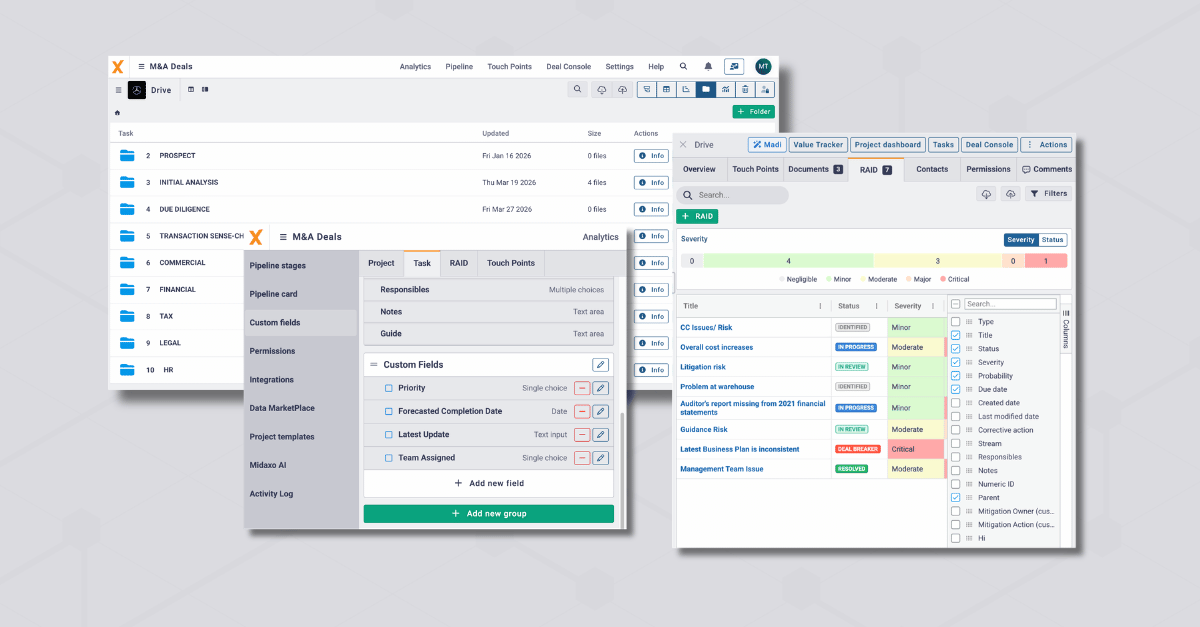
As the M&A Intelligence Platform, Midaxo connects strategy, pipeline, diligence, integration, and value tracking in one system, built for corporate development teams, CFO and finance teams, integration management offices, and PE-backed companies running structured acquisition programs.
The connected lifecycle is the core of the platform. The intelligence layer surfaces signal across phases without taking decisions out of the team's hands.
Midaxo was named a Leader in the IDC MarketScape: Worldwide AI-Enabled Deal Management 2025 Vendor Assessment, and was recognized in the previous 2024 assessment for M&A software as well.
May 13, 2026
•
6 minutes
•






.webp)