Article
PMI
Successful post-merger integration in 4 steps
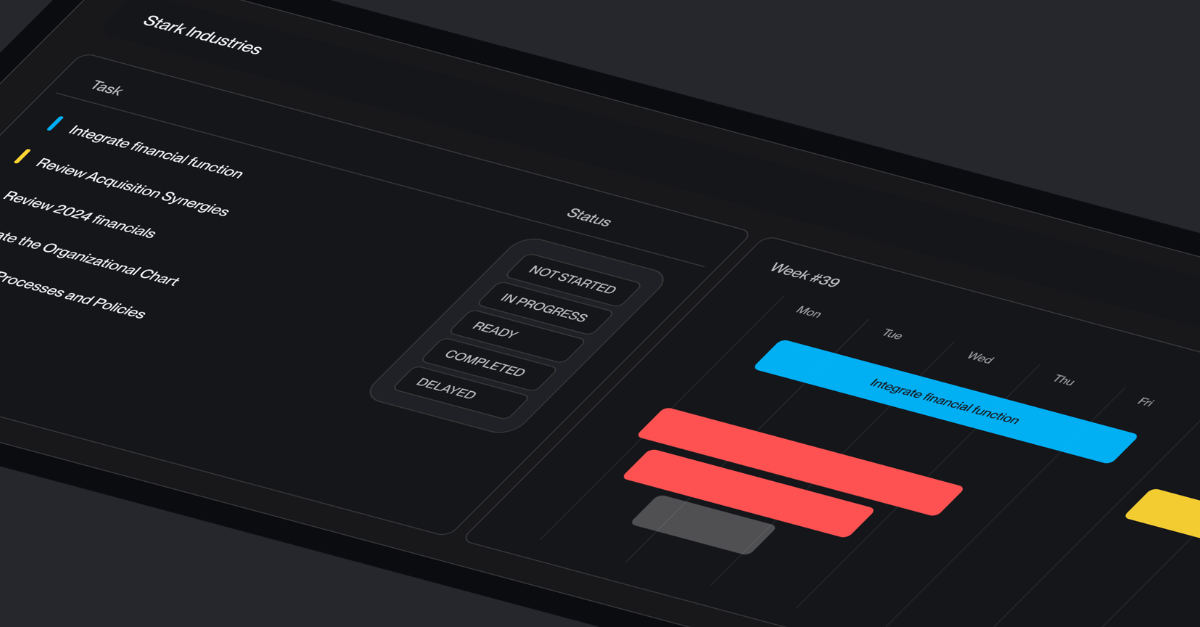
The breakdown of a successful integration project, following four steps in an M&A software platform.
Article
PMI
The breakdown of a successful integration project, following four steps in an M&A software platform.
June 30, 2026
•
3 minutes
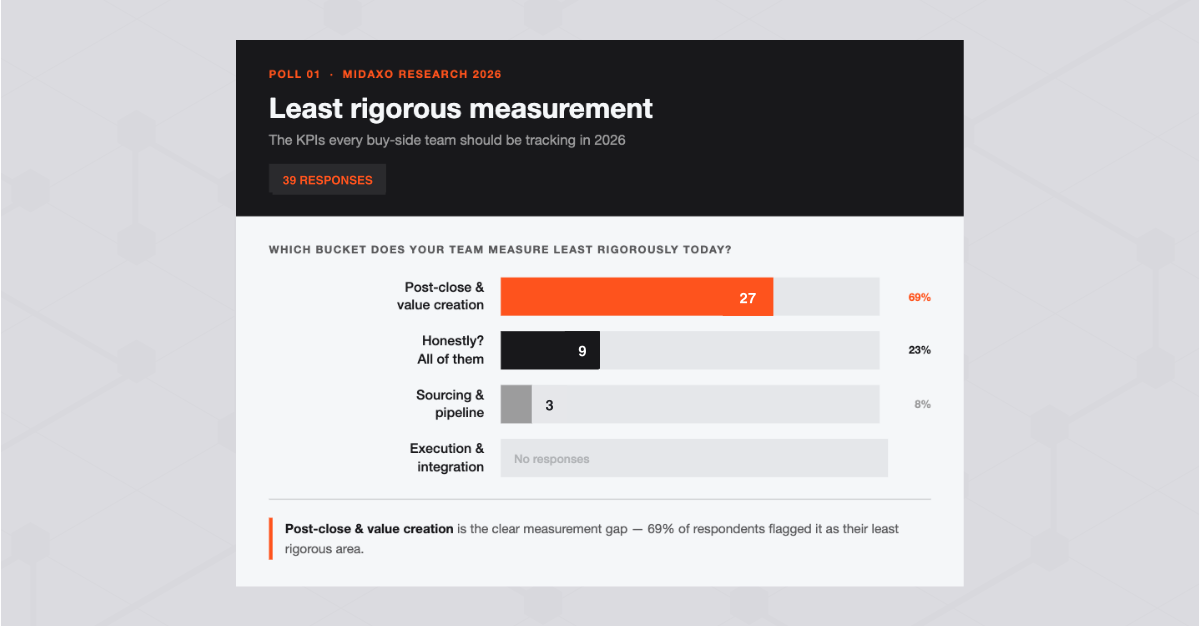
Integration is the unglamorous, high-stakes work that either captures or destroys synergies. The research has stayed consistent for years: most M&A deals still fail to deliver their intended value, and the failures almost always trace back to execution after close rather than a flawed thesis.
The encouraging shift in 2026 is that the gap between acquirers who treat integration as a repeatable capability and those who improvise has widened. Companies that set explicit synergy targets and track them from day one now report dramatically higher success rates. The differentiator is a structured, connected process.
Post-merger integration requires resolute action. An M&A software platform makes it easy to define and communicate a clear integration project plan and track its completion — and, increasingly, to let AI handle the some of the manual work of document review and status roll-ups so your team can focus on decisions.
In this article we'll run through an integration project, following these four steps:
Integration is typically divided into functional streams such aslegal, finance, sales, technology, production, HR, and IT. The integration manager sets the key objectives for each stream and links the relevant M&A due diligence findings, so nothing discovered before close gets lost after it. This matters more than it sounds: a large share of value erosion comes from diligence red flags that were never carried into the integration plan. The handoff from diligence to integration is where deals often lose the value their thesis promised.
Here's how to define functional streams and the objectives for them in a dedicated deal platform like Midaxo:
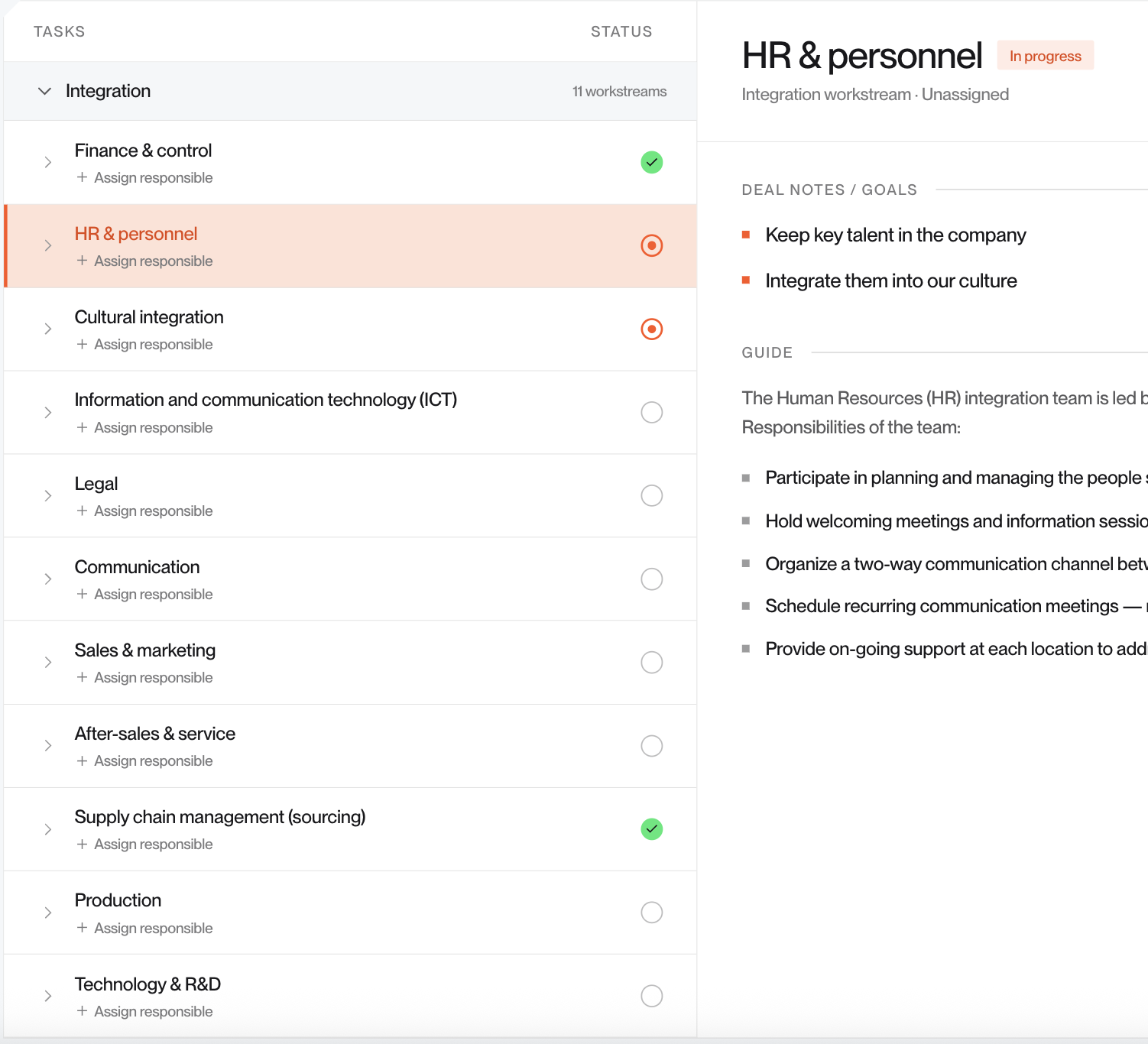
At the start of the effort, stream leaders define the tasks for their streams. A good company-specific integration task list keeps them from forgetting what needs to be done. Midaxo's in-platform playbooks provide a ready-made solution you can use as is or customize to your own preferences.
After the stream leaders have drafted the initial task lists, each stream team holds a stream-specific kickoff meeting where the list is finalized, owners are assigned, and task-level goals and schedules are set.
A large share of integration tasks are standard, while some are specific to the situation. Capture the standard ones in a reusable post-merger integration plan template, so every project starts from proven ground rather than a blank page.
Here's an example of the process to define stream-specific task lists and detailed objectives in a dedicated M&A platform:
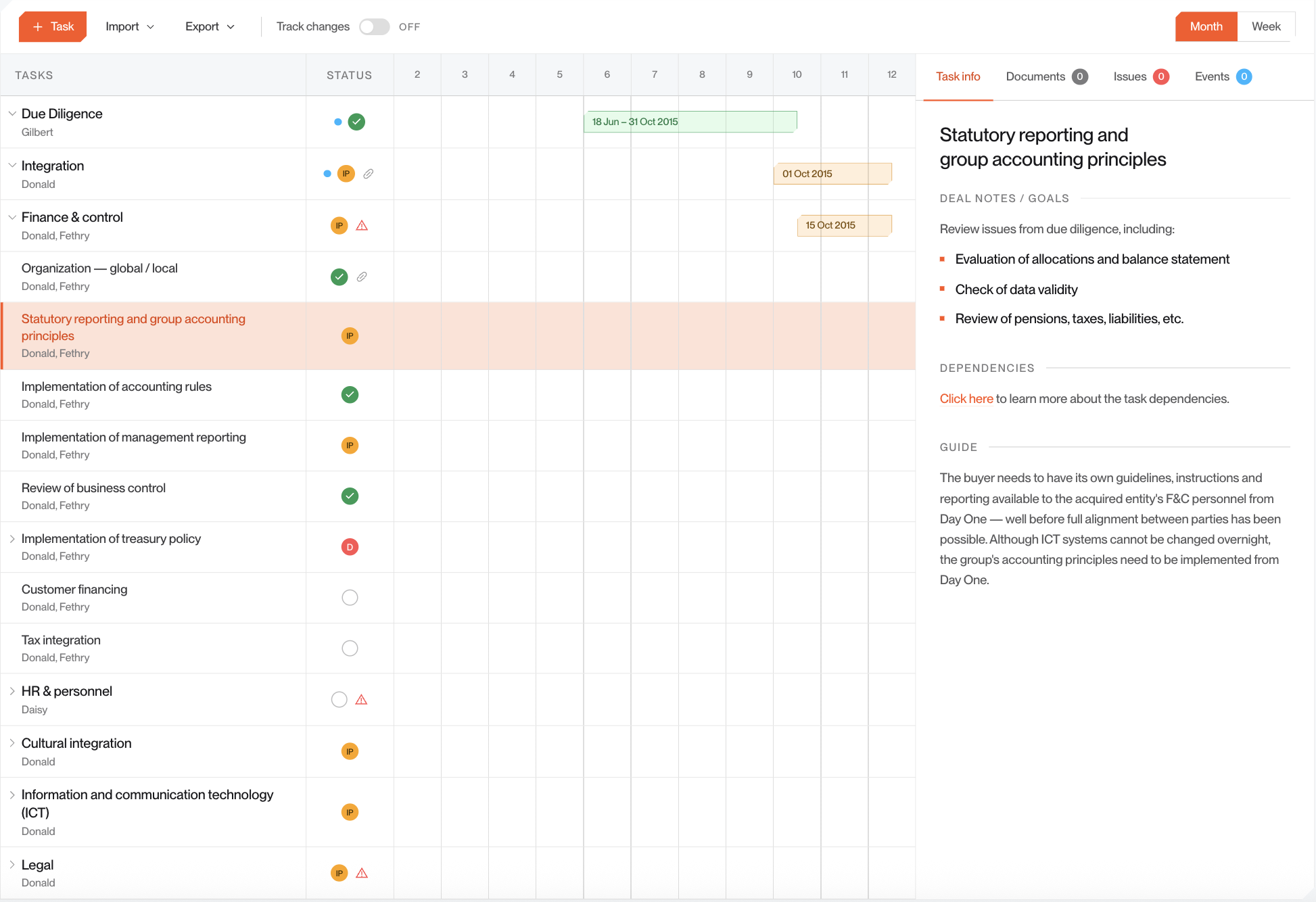
The integration team works from one version of the truth: shared documents, task plans, and context. New team members are productive almost immediately, with less training, because they inherit precise tasks, objectives, and instructions. A single connected platform also removes the need to switch between systems.
In 2026, this is where AI earns its place. Midaxo's AI assistant can scan and summarize diligence documents, flag risks, and surface insights with AI-enriched document review, turning hours of manual reading into minutes so integration leads spend their time resolving issues, not hunting for them.
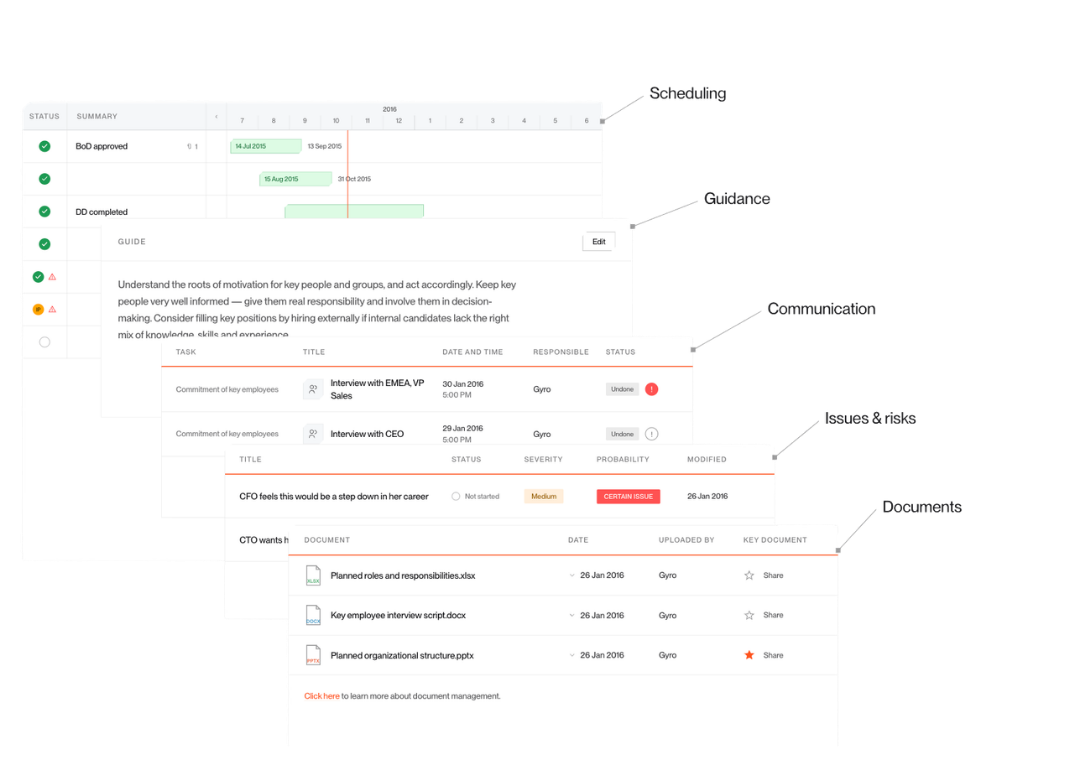
Project stakeholders get real-time visibility into overall progress and can drill down to individual tasks, documents, and issues — no status meetings required to find out where things stand. Crucially, you can track synergies and value realization against the original deal thesis, which is the single habit most associated with deals that actually create value. Clean, dashboard-ready views turn board and steering-committee reporting into a one-click exercise.
The information needed for integration status reports is compiled automatically — owners, due dates, completion rates, risks, and open issues, all current to the minute.
Treating each deal as a one-off emergency is how value gets destroyed. Capturing your approach as a playbook, executing it in one connected system, and tracking outcomes against the thesis is how integration becomes a competitive advantage. See how purpose-built post-merger integration software helps teams plan, execute, and prove value after close. Book a walkthrough of Midaxo.
Jul 8, 2026
•
3 minutes